
Welcome back to Scare Me! a weekly horror newsletter. Today, we’re speaking with Molly Hottle, the owner of my new favorite local-to-me business—Seattle Chainstitch Massacre!
If good and evil exist as discrete forces in the world, the proof may be found in Pride Month discourse about bisexuals.
The evil discourse is as predictable as it is boring—that bi women shouldn’t bring their male partners to Pride events. It’s a dumb take that seems to get dumber every year.
But the good discourse is delicious, and it’s that David Duchovny and Gillian Anderson turned everyone who watched them flirt and yearn and drive each other crazy through eleven seasons of The X Files at least a little bit bi. In my bisexual opinion, this is irrefutably true.
And it’s this very good discourse that introduced me to self-described Seattle stitch bitch Molly Hottle this month—a sewist who’s keeping the art of chainstitch embroidery alive, one garment at a time.
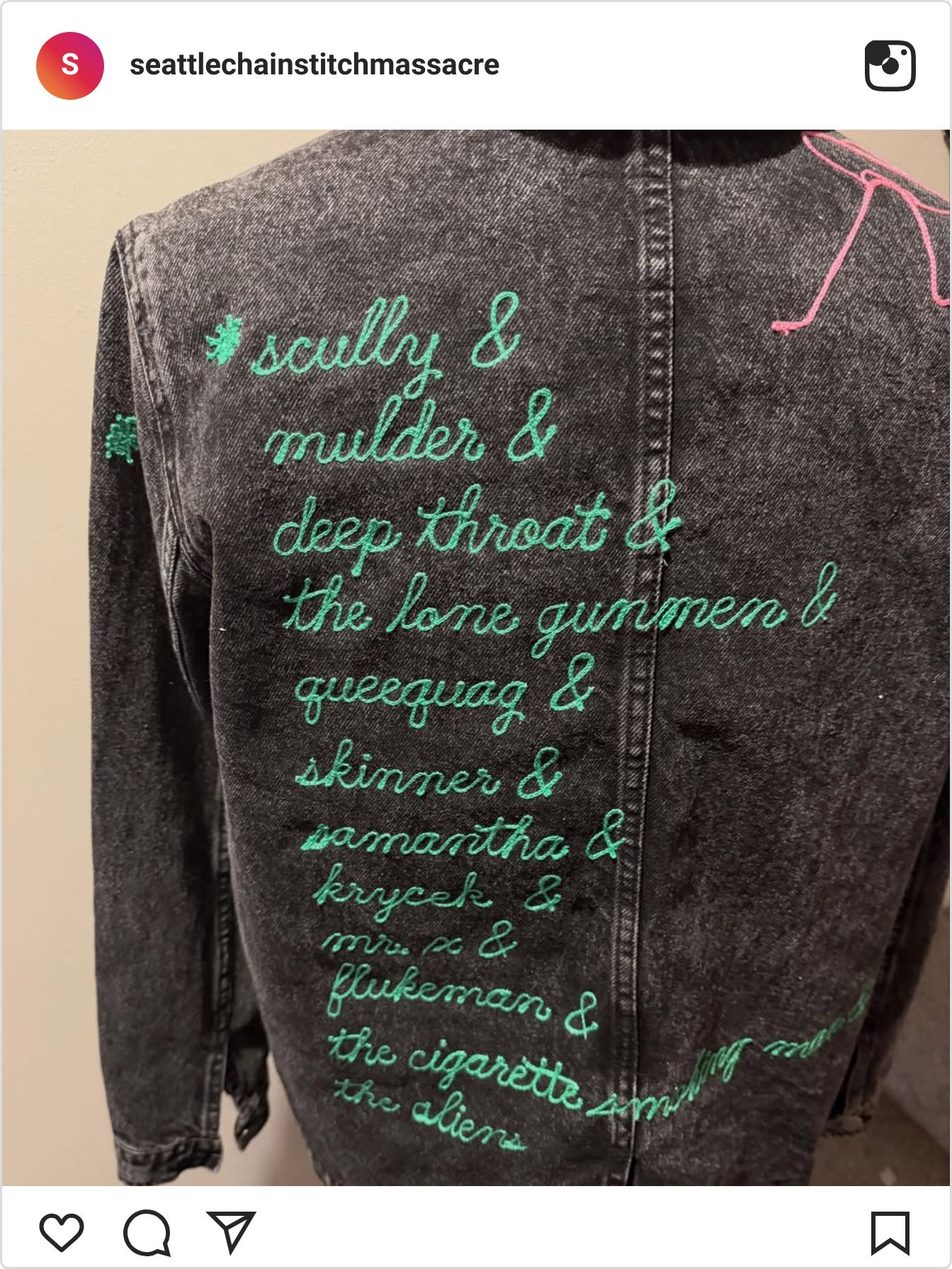
Throughout June, Molly has been posting photos of her custom-made X Files clothing, from vintage FBI windbreakers to denim work shirts. Each garment is immaculately embroidered with a custom image or message—from the infamous Jersey Devil sketch to Molly’s own signature slogan, “Mulder and Scully put the bi in FBI.”
It’s all part of Seattle Chainstitch Massacre, a small business that offers everything from ready-to-wear upcycled garments to live events where attendees can watch Molly operate her vintage chainstitch sewing machine in real time.
I caught up with Molly last week to learn more about how she got into chainstitch embroidery, the unique role horror has played in her journey, and our shared X Files obsession.

Thanks for reading Scare Me! Was this newsletter forwarded to you? Sign up to receive a new edition every Thursday.
Michelle Delgado: Molly! It’s so nice to meet you. I stumbled across your X Files drop on Instagram this past week, and I feel like we need to start there. I love the Mulder and Scully poster you have hanging up behind you.
Molly Hottle: Thank you! I brought it home with me from the Pluto TV bunker.
The bunker?
Pluto TV recently launched an X Files channel, and they had a contest where they basically said, “Tell us why you're the biggest X Files fan and you can spend ten days binging the entire show in a bunker in Joshua Tree.”
It was crazy, so many people sent it to me. They were like, "You have to apply!” And I was like, "All right, I'll do it! I'm sure I won't win.” But I totally did.
That was in March. My friend and I were there for ten days. We watched every episode. It was amazing.
That’s literally my dream.
I posted something a couple days ago where I was like, “It wouldn't be Pride Month if every bisexual you knew didn't say Gillian Anderson made them gay.” It's totally canon, and she's even become more of a gay icon as time has gone on.
[The X Files drop] was actually an idea that came up while my friend and I were in the bunker. We were talking about fun chainstitch ideas, and I was like, “I feel like it is a universal feeling that you are in love with both Mulder and Scully. How do we make that a thing?” You’re bi…FBI…it was such a fun idea. I was like, “Okay, as soon as I get back, I'm gonna find all the vintage FBI shirts. We’re doing this.” It's been awesome.
I love that you’re queering the FBI, too.
I hope they don't like try to come after me. I'm so glad you reached out. I love talking about The X Files, and I love talking about the stuff I do, so it's perfect.
Was The X Files one of your entry points into the broader horror genre?
You know, it's funny. I didn't get this deeply into horror until I was in my mid-twenties. I started to realize there's more than just low-budget gore movies. I think it really was when Jordan Peele started to get popular. I remember going to see Get Out in the theater, and The Babadook—some of these, as they like to call it, “elevated” horror.
I don't do gore well. I don't love the Saw or Terrifier. They all have their place, but that's not for me. I love the sort of cerebral horror.
I definitely wasn't into it when I was a kid, not that it really existed as much. But I watched X Files all the time, and there were only a couple of episodes where I was scared. “Home” is definitely one that everyone had some kind of moment with.
I remember that just after I started watching [The X Files], I was on vacation with my family in Pennsylvania. I was probably eight or nine, and my parents did not want me to watch it—they were afraid it was too scary for me. That meant I had to sneak around, so [when] they were somewhere else, and I was able to access the television, I turned on The X Files, and one of the commercials was for Scream. I just remember the mask. I could not sleep that night because the idea of the mask scared me!
It's so laughable to me now, because that was a horror parody film. That scared me, but I was over here watching spores come out of human necks, like, "Oh, that's fine.” I definitely think The X Files desensitized me quickly. I loved the storytelling, and just that it was different than anything else I saw. That's what really drew me in.
When did you start doing chainstitch embroidery?
I always knew how to sew. My grandma taught me when I was young, and I'm old enough that we still had Home Ec classes when I was in school. During the pandemic, I was doing a lot of [sewing].
And then I saw the movie Nope. I don't think a lot of people liked it, but I loved it. The alien theme, obviously. I'm also a horse girl, so it was this crossover of all these things that I love. In it, Steven Yeun's character wears a red suit that has a big UFO on the back, and I immediately was like, “What is that??” Because it didn't look like anything I'd ever seen before, in terms of appliqué or computerized embroidery. I was just like, “I have to know what this is.” I immediately dived into the costume design and found out it was chainstitch embroidery.
[Pretty soon] I was trying to find my own machine, which is very difficult because they're from the 1930s. There's been nothing in terms of sewing technology that’s been able to replicate the machine itself. All embroidery machines now are computerized, and even if you did chainstitch embroidery on a computerized machine, the character doesn't come through. With chainstitch, I'm doing every single piece by hand—even if I did two hundred pieces, they would all be slightly different.
I tried every which way to find a cheaper alternative, because they're hard to find and expensive, and it just was not it. I finally found someone in Vancouver, Washington, who rebuilds old machines. He's like a wizard with all kinds of sewing machines, but he specifically finds the parts for these chainstitch machines and rebuilds them. I contacted him and was like, "Look, the next time you have one, I would love to buy it.” And he's like, "Oh, I have one right now!” I got it, and I brought it home, and I definitely let it sit there for like three months because it’s super intimidating.
There's like no manual. There's no traditional training for it. I just watched YouTube videos, and there's like a Facebook page that's somewhat active where you can ask questions. But it's really trial and error and just learning the machine for its quirks. It took me about a year to feel like I could take it outside into the world.
Ever since then, [I’ve] been going out and doing live activations for businesses—but also, as you've seen, just doing things I like. That's been the ultimate joy with it: Seeing that togetherness and people resonating with some of the nostalgic pieces.

Steven Yeun in Jordan Peele’s Nope (2022)
For anyone who doesn’t sew, including me, could you describe what it’s like to use a chainstitch machine and how it’s different from a modern sewing machine?
Back in the day, I think people operated them [without] electricity, which would be so hard and time consuming. But now they're connected to motors—you're basically pushing a foot pedal to get the motor to go. The needle goes up and down like a standard sewing machine, but there are many places it differs.
A typical sewing machine has a bobbin. You have a thread coming from the top, and then a bobbin coming from the bottom, and they come together to make a stitch. With chainstitch, you only have thread coming up from the bottom, and the needle is punching through the fabric. It's pushing and pulling the thread to make a chain shape. The question that sewists always ask when they walk by my table at events is, “Where's the bobbin?!” And there isn't one, which is great, because you only have to worry about one spool of thread.
These machines last a long time, way longer than the plastic machines that are made now, because obviously they're made of iron. It's very strong, but they're also very temperamental. A lot of the moving parts that touch each other are metal, [I’m] almost constantly oiling it.
If one thing is off, you have to investigate the whole thing. It just happened to me yesterday, where I was like, “The needle's facing backwards. Why is that happening?” You kind of become a mechanic at the same time that you're learning it, which is not something I anticipated and not something my brain works well with. It's been a huge learning curve.
For computerized embroidery machines, you kind of do this thing called “set it and forget it.” You digitize a design, you put it into the computer of the machine, and then you just say “go.”
[Chainstitch] is all done by hand. If you were to see me stitching, my hand is usually on top of the table next to the machine as sort of a guide for whatever I'm stitching. And then my other hand is actually underneath the machine, because there's a joystick, and that’s how I direct where the needle is going to go. That's why even if it's the same design twenty times, it'll be slightly different—because it's my hand, and the variables are too great to make it exactly identical.
That sounds like it would be deeply satisfying, once you get the hang of it.
It really is. I have so many people who stop by and say, “I just want to watch you.” It has a soothing, motorized sound. It's definitely not quiet, but it's kind of a rhythmic sound. I even find myself feeling very soothed by it.
I have such a long doc of ideas that I want to do, and I think that's really what keeps me motivated. And just seeing a finished piece, especially one that takes a long time to do, feels like it's almost the opposite of the world we live in right now, where everything is immediate satisfaction and gratification. This refuses to be that way, and I think that's also part of why it's sparked so much excitement among people who see my work. They're like, “Oh, this is more than just some mass produced thing. This is unique.”
It's not going to come quickly, and as frustrating as that might be initially, I think the payoff is so, so good.
Do you know anything about the history of your specific chainstitch machine?
That's great question! I know a little bit. I think it was used in a tailoring operation of some kind. I [also] have backup ones that I've collected, just in case. When you build your business on a temperamental machine, you have to have a backup.
There's a very small letterman jacket company in Fife, near Tacoma, that I found through some connections. I reached out to them and said, "Hey, if you guys are ever looking to sell any of your chainstitch stuff, I'd be willing to buy it.” I ended up buying a machine from them, and they were the only owners. The business has been around since the early 1930s or ‘40s—they still make letterman jackets, but they don't really do chainstitch anymore. They do moss stitch, which is the fluffier letterman jacket style.
I still talk to them all the time. I bought thread from them the other day. They seem to be doing great, which is nice to hear.
Is there something that you’re dreaming about making some day?
Definitely. Orville Peck is coming to Bumbershoot, and I'm like, "Come on, guy! Just call me up!”
Before recent history, I would have said doing something for my favorite actors. But after the Pluto TV bunker, I went to Denver Comic Con and met Gillian Anderson. She was the only one I hadn’t met of the cast, and I put it out there while I was doing some press about the bunker.
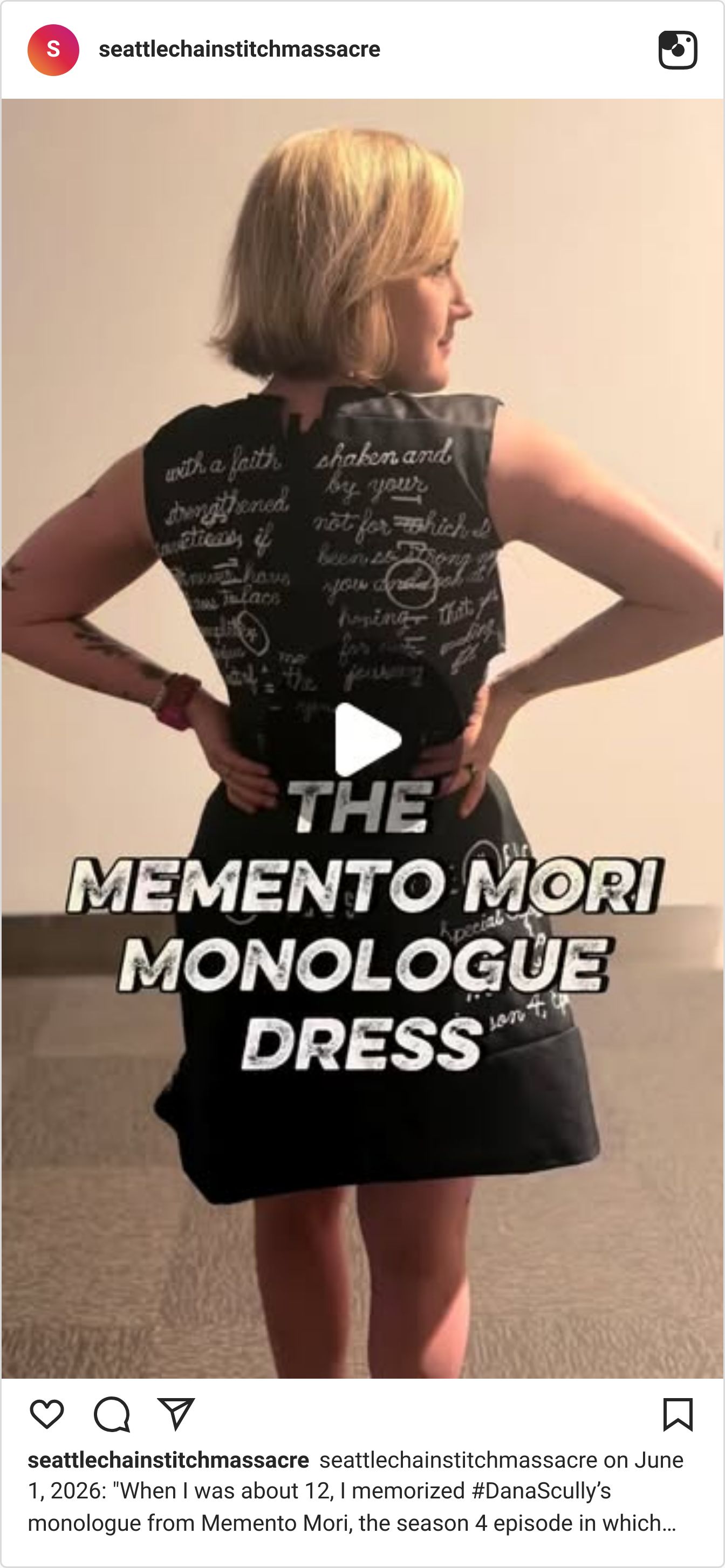
As a kid, I decided that if I ever met Gillian Anderson, I would recite the monologue she gives at the beginning of “Memento Mori,” the cancer episode. I still had it memorized, and the Pluto TV people got in touch with her people, and she sent me a video message saying, “I'm going to be in Denver Comic Con. You can come do the monologue if you want.” I was like, “Oh my god. Well, I'm not going to do that.” But I took the pillows from the bunker—because they were all X Files branded—and I cut them into a dress, and then I stitched the monologue onto the dress.
When I showed up [in Denver], I was like, “Okay, I put it here because I don't think I'm gonna have the guts to do it for you.” And she was like, “Oh my god.” It was awesome. I also made her an embroidered jean jacket with a pet portrait of her dog, Stella, on the back. People love pet portraits, so I was like, “Maybe she'll actually like this!”
That was definitely like a dream realized, or many dreams realized in one, for sure. I just saw a chainstitcher the other doing the Toy Story 5 movie premiere—she was on the red carpet, stitching bandanas for people. Which is very stressful, by the way! I think that that is one of my next, like, put-it-into-the-world things I would love to do. A movie premiere, or a horror movie wrap party gift—something like that would be so cool to do.
To bring it full circle as we wrap things up: What’s your favorite episode of The X Files?
Without a doubt, my favorite episode is “Triangle.” This is one of my Roman Empires—I don't know if you've ever watched True Detective, which I love. In the first season with Matthew McConaughey, there's this scene people were just raving about. They're like, "Oh my god, this hasn't ever been done in TV before!” It was this single shot, for maybe the last twenty minutes of the show, which is great and incredible and awesome and very hard, I'm sure.
But imagine you do an entire episode with four shots. Like, sorry, but fuck off. This has been done before, and it was The X Files that did it.
I love everything about that episode—the set pieces, the juxtaposition of now and then, all of it is so good. But that's my favorite part about it. It was so groundbreaking for television at the time, and I think that's something people talk about a lot with The X Files—there were so many things about it that set precedents, and I don't know that they always get credit. But I think that [scenes like the one in True Detective] exist today because of the show, which is just awesome.
Up Next: What Does Widow’s Bay Smell Like?
Next week, our perfume correspondent Sophie Desmond is back with a brand new curation! So many horror fans have fallen in love with Widow’s Bay this summer—a horror comedy show on AppleTV that follows a fictional New England town beset by an ancient curse.
From wave-washed beaches to weathered wood shingles, the aesthetics are East Coast beachy and we deserve perfumes to match!

Scare Me! is a free weekly horror newsletter published every Thursday morning. It’s written by Michelle Delgado, featuring original illustrations by Sam Pugh. You can find the archive of past issues here. If you were sent this by a friend, subscribe to receive more spooky interviews, essays—and maybe even a ghost story or two.
