
Welcome back to Scare Me! a weekly horror newsletter. Today, we’re speaking with Ryan Samuel Carr, the George A. Romero Foundation’s supremely talented artist in residence.
If beauty is in the eye of the beholder, then monsters can most certainly be beautiful.
At least, that’s what I think—and I’m not alone. First on his Instagram, and later in graphic novels and comic book covers and gallery shows, artist Ryan Samuel Carr has found beauty, tragedy, and compassion in portraits of classic monsters.
These playful drawings, first penned during lockdown, have led to opportunities Ryan never could have predicted. Since 2020, he’s served as the George A. Romero Foundation’s artist in residence—a role that’s ushered in new opportunities ranging from a full-length graphic novel to covers of the iconic Creepshow anthologies to a memorable dinner at director John Carpenter’s house.
On a recent video call, we chatted about Ryan’s fine art background, our shared fascination with the grotesque, and the surprising opportunities and connections that have blossomed as he’s worked within the horror community.
Ryan is so much fun to talk to, and very kind—I’m thankful that he indulged the many tangents that I had to trim down! What’s left is a conversation about the nature of art and beauty that I’m still thinking about, two full weeks later.
A note, before we dive in: Just a few days before our interview, the news broke that GARF president Suzanne Desrocher-Romero had passed away after a long illness. My sincere condolences to everyone who loved, knew, and worked with Suzanne. The horror community lost one of its fiercest and most inspiring advocates, but her legacy will most certainly live on.

Thanks for reading Scare Me! Was this newsletter forwarded to you? Sign up to receive a new edition every Thursday.
Michelle Delgado: Ahead of our conversation, I read up on the George A. Romero Foundation, where you serve as the artist in residence.
I was surprised to learn that the GARF was founded in 2018—in less than ten years, the GARF has established a Horror Studies center at the University of Pittsburgh; restored and distributed rare archival works; and supported emerging filmmakers through scholarships and awards, to name just a few of their many accomplishments. It’s astounding what their small team has accomplished in such a short period of time.
You joined in 2020, so you’ve been there nearly since the start. What has that experience been like?
Ryan Samuel Carr: I felt like I was taken under their wing really quickly. Their art director found me during Covid. I was just doing silly stuff, monster drawings, and they asked me to do something for their newsletter. And then I was in, and it just was snowballing.
George had written a zombie story called “Outpost #5,” and [the GARF team] wanted to do a new version. They would start with his first chapter, then have other creative writers—Daniel Kraus and other zombie aficionados—come in and add chapters to it for the newsletter. I was doing the title drawings for each one.
It started with that, and then, yeah—all of a sudden, “we need a t-shirt here, maybe you could come up with a design,” or “there's a 40th anniversary of The Howling, we're gonna have Joe Dante come and talk to the foundation, could you whip up something?” They kept me busy. It just kind of seemed like I was part of the family after a point.
I love those guys—they're just all as nerdy as we are. They just love this stuff, they could talk about this stuff all day long. It just seemed really like a natural fit.
When you say you’d been doing monster drawings, do you mean like, since you could hold a pen? Have you always been drawn to monsters? Or was that something you started doing more recently?
Before Covid, I had done a series here in Ventura about native and invasive plants. I had done a huge project where I was making paper out of invasive plant species, then doing illustrations of local native plants on the invasive plant paper. Fine art was where I wanted to be. And then Covid hit, and I thought I'd start having fun and just doing stuff for myself—which ended up being a lot of classic monsters doing poses from fifteenth century Dutch paintings.
I'm really happy that I was doing that, because that ended up leading to [other] things. This is all just fun, doing this monster stuff. I can't believe where I'm at [now] with the horror genre. It's great.
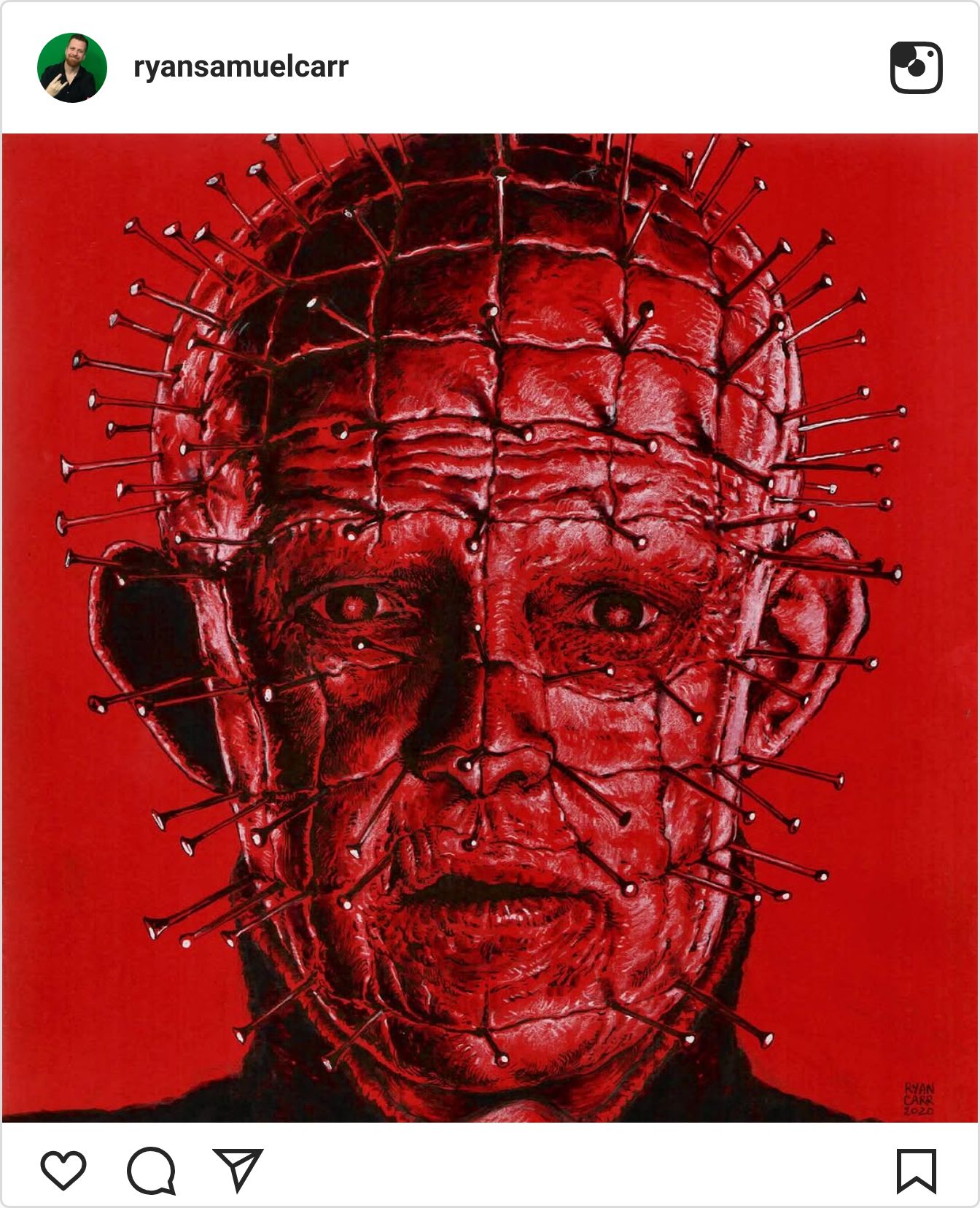
You hit on something that I wanted to ask about—when I was looking through your Instagram before our call, I was really struck by the close-up portraits of classic monsters you’ve done. You have a knack for capturing complex, mixed emotions.
There’s something about the musculature of the face, the expression of the eyes, the tilt of the mouth—it’s this crazy alchemy that radiates so much emotion, even if it’s on a non-human face like the Creature from the Black Lagoon. It’s interesting to hear that you’re bringing a fine arts background to these monsters.
I was always doing figure drawing and portrait drawing classes in high school. I’ve always been into fine art classical portraits, so I guess that comes through!
You always have empathy for the monster, too—at least, I do. A lot of those classic monsters, you see where they're coming from. They have tragic backstories, and I like to think about that when I'm drawing them. I think it all does come through as a sense of empathy.
And then I just love all that musculature study from figure drawing. I taught figure drawing for a couple years for the museum here locally, but I had to stop because I just wanted to draw! That's awesome that you responded to that—that really means a lot, that's super cool.
Do you have a favorite emotional register that you like to explore?
I like to think about the word “grotesque,” and what that means, and how we get to that point. In art school, that was something we talked about a lot. It's very Daoist to have that word, because you can't have it without beauty, right?
But those two things can kind of intermingle. When I was drawing plants, those two things are there. If you get close up to botanicals, they're hairy and weird and completely alien. But we call a flower a flower and think of it in a certain way, as something beautiful.
I think grotesque and beauty have a funny commingling that I like to think about a lot. Especially with monsters. I mean, what's a monster? It’s supposed to be the ugliest, scariest thing, but these are things we create, and that we are, too.

At this point I went on a long tangent about the grotesque monsters of Silent Hill, and Ryan very kindly indulged me. Perhaps a subject for a future newsletter!
For me, that calls to mind the conversations around the imprisoned woman in Barbarian or Aunt Gladys in Weapons. Often, it seems like we’re meant to view old bodies, or old women’s bodies, as something frightening or grotesque.
I had fun watching those movies. I’m definitely not a hater! But it’s something I think about still.
Right? There's a lot of films that play on our terror of aging, and so the nude old body is the focal point. I always go back to Hereditary—the scariest part in that movie to me is the old guy in the hallway, naked. That was such a shock.
I was prepared for the decapitation. No one warned me about the naked guy!
That was the worst part of the movie for me! There is just something [about] being confronted with your body and what aging looks like. You think of the old lady in the tub in The Shining—I think there is this trope of aging and nudity. As a Western society, it's like we're supposed to be really scared of this thing.

That’s a perfect segue into one of your biggest projects with the GARF—a graphic novel adaptation of a 1975 Romero film called The Amusement Park. That’s all about aging and ageism, right? There’s a lot of interesting things you can do with wrinkles and shadows—a lot of detail to work with, while drawing older bodies.
I like drawing details a lot anyway, so yeah, it's funny—I think there were a lot of times where I was just drawing that because I liked drawing it, and then people would call it grotesque. That's kind of interesting, the reaction people have. Lots of wrinkles are supposed to be grotesque or something, but I don't see it that way, ever.
The Romero Foundation showed me The Amusement Park during Covid. I just thought it was so relevant because people were supposed to be [sheltering in place] because we were supposed to be taking care of the elderly. And there were so many people who were still not doing that, because they didn't care.
Ageism is still totally a thing, and taking care of the weak and the elderly is very important. As an evolved society, we should be doing that and thinking about that.

Have you had the chance to hear any responses from people who have seen or read The Amusement Park?
Working with Sandy Carpenter was so amazing. We did a mini tour in LA when it came out—we screened the movie and did a little talk together at this place called Vidiots. That was one of the most fun things I remember doing.
I've gotten to know the comic group who make the Storm King comics so well. That was something I'm really glad came out of all that, because they're such a cool little tight group of people. And of course, meeting John Carpenter was one of the biggest things ever. We had dinner! I got to go over to have dinner at John Carpenter's. That was bonkers. All that stuff was amazing, but just getting to know that little group was awesome.
As far as like reviews, though—there are a few reviews online, but I definitely will hear it more in person when I'm doing a signing or something. People will come up and say they read it and they really liked it. All the best stuff has been in person. That's been really cool.
Now that you’ve completed such a longform project and it’s out in the world, would you want to do it again? Do you have any projects that you’d love to do?
I have a back burner sci-fi thing that I'd really like to do. I'm just really into atomic age sci-fi stuff. That would be a dream project, for me to write and come up with a fun atomic age monster sci-fi thing. I just love that—that's the stuff I grew up on.
If I were to get completely indulgent in my nostalgia, that would be like exactly what I'd want to do.
To wrap up our conversation, I wanted to make sure I ask the most obvious question: How did your relationship to horror begin?
I was first doing sci-fi as a little kid…but I think I really started falling in love with horror at the video store.
Other people talk a lot about walking down the horror aisle at the video store. It's like your first art gallery, seeing those covers. For a kid, that’s the craziest shit you've ever seen.
Up Next: Introducing This Might Sound Strange

“The Living Night” by Chris Panatier
For the past eight-ish months, I’ve been working hard on a new project—and next Friday, it will finally be out in the world. This Might Sound Strange is a horror podcast where tarot cards guide the conversation. It’s hard to believe that after so many evenings and weekends spent developing the concept, building a website, booking guests, and recording interviews, we’re finally on the brink of launching the first episode.
The premise is simple: Ahead of each author interview, my co-host Maya Rector draws three tarot cards at random. From there, we develop all of our questions around the themes suggested by the cards. Tarot is incredibly literary and rich with symbolism—a perfect entry point for interrogating works of fiction. You can think of it as a tarot reading for the book rather than the author.
In case you’re unfamiliar with the practice of bibliomancy, Maya wrote a primer for her newsletter this week. To our delight, the format really seems to work. Lucy Rose, who wrote The Lamb, said it’s her favorite podcast she’s been on to date (!!).
After that, I have so many fun interviews planned for the newsletter it’s actually nuts. This summer is busy and fun in the best way!

Scare Me! is a free weekly horror newsletter published every Thursday morning. It’s written by Michelle Delgado, featuring original illustrations by Sam Pugh. You can find the archive of past issues here. If you were sent this by a friend, subscribe to receive more spooky interviews, essays—and maybe even a ghost story or two.
