
Welcome back to Scare Me! a weekly horror newsletter. Today, we’re speaking with Kailee Pedersen about her new book The Minimalist, freshly published on 8/18 by St. Martin’s Press. This newsletter discusses suicide, parental loss, grief, and self-harm. If these are sensitive topics for you, please take care while reading.
I love seeing people annotate their books—pages frilled with sticky tabs, highlighters scattered—but I don’t typically participate. I like to read books straight through, occasionally jotting a thought in my notebook. Otherwise, I try my best to lose myself in the story.
The Minimalist changed that. It’s so emotionally potent, so sharp and precise in the way it needled my heart, that it demanded marginalia. I wrote things like: “Ouch.” “Goddamn.” “Same.” “Brilliant.”
The novel captures Mia Voss, a brilliant minimalist composer, in the empty aftermath of loss. She’s taken up residence in her longtime mentor Ryder’s house, which she’s inherited after his death, and she feels compelled to complete his final composition. But as the days blur by, Mia’s grief and the music demand greater and greater sacrifices.
When I interviewed Kailee Pedersen a few weeks ago, I couldn’t stop a flood of confessions from derailing my questions. Like Mia and Kailee herself, I was adopted. My life has also been shaped by suicide, following my birth mother’s lonely death at just 46 years old. And to be completely honest, I’ve also heard the siren song of self-harm, primarily in the form of an ED that I’ve only recently managed to kick.
This book is incredibly special to me—a gutting psychological horror that plunges the reader deeply into Mia’s complex pain. I’ve also included some music throughout: examples of the minimalism that, as we’ll see, influenced the aesthetics and form this novel takes.
Note: This is a long interview, but I just couldn’t cut it down any further! If it cuts off in your inbox, click “Read online” to see the blog post version.

Thanks for reading Scare Me! Was this newsletter forwarded to you? Sign up to receive a new edition every Thursday.
Michelle Delgado: I’ll say right off the bat that I loved this book. You’ve truly created something extraordinary.
Kailee Pedersen: I'm so honored it resonated. I'm hoping it'll find similar-minded readers. But ultimately, I really wrote it for myself. I really needed to get something out there about my experiences as an opera singer, a classic musician, an adoptee. It just coalesced in the book.
Before reading this novel, I don’t think I realized how much tension and potential horror exist in the world of elite classical musicians. Afterwards, I couldn’t think of a book or movie that engages music as directly as The Minimalist. Even on a sentence level, the novel’s language is steeped in music.
I’ve seen films that are set in similar environments, like Black Swan or Opera, but they don’t tend to center music in the way you do.
A lot of works about classical music, which I love dearly, are really vehicles to do other things. Classical music is an aesthetic or the backdrop. And that's totally fine, I have no issue with that whatsoever.
But I was thinking, wouldn't it be really interesting if I brought in my own deep experiences as an opera singer? For a long time, I had wanted to write about my adoption and my experience with Jewishness, queerness, and mental illness. I felt that these all were really impacting me [while] writing.
That's one of the differences of The Minimalist to other works about music. The music is not merely something that's spooky. It's inextricable from the fabric of the work itself. It's everywhere within in it.
We’re so locked into Mia’s perspective, and she sees everything musically—even the ambient sounds in the house.
Sometimes art is characterized as being esoteric, but the physicality of the music is so apparent in The Minimalist. As a trained opera singer, did you set out to write a book that fellow musicians might recognize from aspects of their own experiences?
Some of it is exaggerated for drama—it’s a novel, not a documentary. I tried to aim for 60–80% authentic experiences psychologically, and then 20% freaky shit for the horror elements, as one does.
For me, if the basis isn't honoring reality, then all of it falls apart. It's kind of like when I watch a movie and set in Nebraska—which is where I grew up and where my first novel is set—and it's very clear they've never been to Nebraska and have no understanding. It really takes me out of it.
I would say a lot of the pressures—the self-hatred, the anxiety, the relationships to your mentors and teachers, and the competitiveness—are all very real. And also the joy. I was really aiming for an experience of what I would describe as the agony and ecstasy of music.
There are hours and hours in the practice room, and sometimes very abusive behaviors in the industry. But when everything really fits together, and you really feel like you did something great, it can be transcendent.
And then, of course, there are experiences of mental illness, which I share with Mia. Some of that was made more extreme or compressed or pulled around in certain ways within the narrative to make it more of a dramatic or horrific scene.
The same with adoption. Speaking as adoptees, there's probably a lot, hopefully, that you related to—that felt really real. And then stuff that you could probably see was real, but it's also [manifesting] in a horror context. That's not to say it's a lie, but that it's a novel, and we have to make allowances for that.
As an adoptee, I found it incredibly refreshing to read about the more difficult aspects of an experience that’s so often sanitized. There’s a line that truly broke my heart, where Mia recalls that the orphanage described her as an infant who was “difficult to love.” There’s a sharpness to that moment that encapsulates so much. Was that something you honed carefully, or something that tumbled out onto the page?
When I was writing this book, I was studying the role of Cho-Cho San. Madama Butterfly is a really famous opera that appears very frequently in the novel, in which a Japanese geisha is in a relationship with an American sailor. He impregnates her, leaves for three years, and then returns to take custody of their child. She gives him their child and then kills herself.
I was really struggling portraying this character because I didn't understand why she would do all that for him. I didn't understand what was going through her mind. What is this character who is so willing to degrade herself in various ways, just to feel a little crumb of love?
That [line] kind of came to me—I think it first appears when [Mia] mentions her adoption files, but then it also appears very critically during a conversation with her mother. Her adopted mother says, "You've always been like this. You're difficult to love.”
I think that's something a lot of adopted people have experienced—this feeling [that] we're different or we don't belong or that there's something wrong with us. It's a very encapsulating explanation of those abandonment issues that can crop up. My work is very deeply psychological, so I was looking for a way of entering [Mia’s] psyche to explore that feeling of like, “I'm gonna have to work at this, or everybody will abandon me. I'm gonna be alone.”
Do you think there’s a relationship between being adopted and being a high achiever? I’ve always felt the need to prove myself or earn my place.
I'd be remiss to not mention the stereotypes for East Asians. There's a scene in the novel where Mia is playing for a very famous pianist in a masterclass, and he says, "Don't play it that way. I know that in Korea they don't sing.” Which is based on a real thing that happened in an actual masterclass. A white masterclass teacher told some students that basically, they were being too Asian.
There's this dynamic in classical music, where if you're Asian, you're expected to excel, but you are also stereotyped with this idea that you don't have emotion, that you aren't emotively correct. Some of that gets into the book.
I do think there's some sense of like, “If I'm difficult to love, I'll have to do what I can to make myself lovable.” For me, there was some of that in my personal experience. It's kind of challenging to untangle, because I think ultimately a lot of that, frankly, comes to nothing, right?
That comes through when Mia talks about her girlfriend. She hears her girlfriend sing, then she immediately starts critiquing her girlfriend's voice. This is funny, because I didn't want to base the voice on anybody in particular, so I based it on my own singing voice. All the stuff Mia doesn't like about her girlfriend's voice is what I don't like about my own voice. But her girlfriend enjoys singing and performing, and she doesn't have poisonous contempt for the music. That's something Mia can never relate to.
I think some of that is not just an adoption [thing] or a racial thing, but the arts themselves. I would not say that to another aspiring writer, but I would tell them it's a really hard road. I can't in good conscience just be like, yeah, do it! Because it is so hard. It’s fucked up economically, it's tough mentally.
I'm not trying to write this book and be like, “Classical music is torture.” I actually really wanted it to convey on some level what I get out of classical music as a singer—but also, as I mentioned before, being realistic about the challenges of the field.
The novel has such an interesting, mesmerizing structure. Sections alternate between the present intensity of Mia’s grief, and the past that led to this moment. It’s hypnotic. How did you sustain that tension and pacing?
The novel takes influence from minimalism itself, which is a avant garde musical style that originated in the 1960s. For folks who love soundtracks, Philip Glass is a really big name in the minimalist world. He did the soundtrack to Candyman and also Koyaanisqatsi. You can hear in his music, as with a lot of minimalists, these little packets of sound and melody that are repeated over and over and over again, and then often layered on top of each other in increasingly complex and baroque formulations.
That's really what the book does. You take these memories, sometimes the same one over and over again, through layering and repetition. I admit that this book is not really for folks who are looking for an action-packed novel. It is really about memory, psychology, and an emotional journey. That really led my way, just taking inspiration from the music.
I also tend to feel that people with any kind of trauma history tend to experience memory non-linearly, and that's the same for me. In some ways, I was attempting to replicate that disjointedness. At one point, Mia says that she felt that she came into being on the tarmac of the airport—that she wasn't really born in China, but that she started to exist when she came to America. There's a sense for me, especially as an international adoptee, that there's this whole world and life that I left behind or abandoned, that has just disappeared into nothing.
I tend to write very intuitively. There were edits, but the structure kind of stayed the same. This is later in the book, and it might be sort of a spoiler, so I'll keep it vague—there's a section that is essentially a dream sequence. That was very complex to manage, because it's told in reverse order chronologically as well. Not only does the time not really move forward—it sometimes goes back in a kind of recursion—but it also will sometimes even literally move backwards.
Side Note: I saw Philip Glass perform a concert when I was in college. He told the incredible story of his friendship with Allen Ginsberg, whose poetry inspired and is included in “Witchita Vortex Sutra.” The cassette tape of Ginsberg reading the poem was lost for many years, until Glass discovered it in a drawer—a haunting, electric resurrection of his deceased friend’s voice. Chills!
I hesitate to describe Mia as an unreliable narrator, because that can imply that a narrator is deceptive or manipulative. But Mia is incredibly hard on herself, and we meet her in a moment of profound crisis.
I often wondered if there was a gap between the way she views herself and how the world sees her. The novel doesn’t use quotation marks, so I wondered if we were only seeing other characters’ dialogue through Mia’s perspective. How much should (or shouldn’t) we question what she’s telling us?
I think you can question what she's saying—but for me, it's more about riding out the wave with her. Sure, she might be saying something that wasn't intended by the speaker, but I also think that's like real life, right? We've all overreacted or responded to things in a way that maybe wasn't appropriate. She has both a lot of self-awareness and also very little self-awareness at times. I think that’s very true of humans.
I'm always very interested in characters that are kind of unpleasant and challenging and difficult, but remain interesting. I definitely took inspiration from a very famous unreliable narrator, which is the narrator Lolita. That character is extremely charming and educated, but also deeply depraved and uncomfortable deep down.
Obviously, Mia is not nearly on the level of Humbert Humbert, but there’s some similarity. She's extremely educated; she does something that's very rarefied, which is composing classical music. But deep down, she's a ball of insecurity [and] anxiety, and she takes it out on people.
She's very cruel to [her ex-boyfriend] Oliver. There's something interesting there, because he seems to be much more stable and even keeled, but at the beginning you find out he is the one who has killed himself.
Going back to your discussion about adoptee portrayals, I deliberately wanted to have two adoptees with very different experiences and relationships to decisions like searching for your birth parent or how much to care about your past. I think Mia is very interesting, because she completely rejects all of that, which is not the standard narrative, I would say. She doesn't reject it because, “I love my adoptive parents so much and I’m fulfilled.” She just rejects everybody because she hates them.
I loved that we get to see different experiences of adoption through Mia and Oliver. In my experience, unless you seek out the company of other adoptees, it’s somewhat rare to cross paths with them. I initially thought it would be a point of connection between them, but they have such intensely different reactions.
It's a disaster. They break up, they have a pretty bitter relationship near the end of his life—and she's still his in some sense. There's not a sibling rivalry, because they've also had a romantic and sexual relationship, but there's almost this sense [that] Oliver feels that his father Ryder favors Mia, because Ryder views Mia as the heir to his compositional work. Oliver is just kind of there.
No matter how much of a prodigy Oliver is or how beautifully he plays piano, there's this creation that he feels incapable of. Playing music feels secondary to composition in the hierarchy of Ryder’s little family unit, is how I read it. Was that what you intended?
A little bit. And I think there's a lot for me about inheritance—not genetically necessarily, although there is some of that. But also, professional inheritance. Do you take on your mentor's work? How far will you go to complete it? And then also, inheritance through adoption. In Oliver's case, he does meet his birth mother, and it's an unhappy parting. What does he inherit through blood?
The fact that Oliver’s birth mother was also Ryder’s student is very interesting. It adds another layer of of complexity.
I guess something I'm kind of dancing around is how in horror stories, adoption is often saved for a big reveal. Adoptees or their birth parents are often threat. They're interlopers who disturb and unsettle the nuclear family.
Yeah. It's a thing in the Gothic—Heathcliff is a racialized foster child, there to destroy the family. I would even argue Frankenstein—[the monster] is not really a real child, he's made of corpses.
The Orphan series. The Ring.
The Changeling. Of course, I think it intersects with generally the fear of racialized or people of color as well. The sinister person of color.
Were you writing against those tropes in horror? It’s something I think about all the time, but I’ve never had the chance to talk to another adoptee about it.
Maybe a little bit. I wanted to depict adoption and adoptee experiences in an honest way.
I do find myself getting frustrated by those tropes. It's not that adoptees need to be perfect, or even [have] positive representation. It's just [that] I find it to be quite lazy. I also tend to be frustrated because I feel adoptees are so frequently depicted by people who have no relationship to us.
I'm not saying you have to be adopted to write about adoptees. I don't believe in that kind of thing. But I think it's probably for the best if people would consider researching or consulting us, or reading some memoirs to try to understand the complexities.
It does frequently feel like either the adoption is a twist or there's something wrong with their bloodline that gets kind of funky. I think it's just me and Dan Chaon, actually, who are adopted and writing in the horror genre. [There] potentially may be some other folks that I don't know about.
When the representation is truly so minimal, it's hard to see [that] even well-meaning works by people who don't have our experiences [are accepted] as the truth more than our works about ourselves.
I’m sure some people do have a wonderful experience with adoption. But for those of us who didn’t, it’s nice to see alternate narratives counterbalance the common tropes.
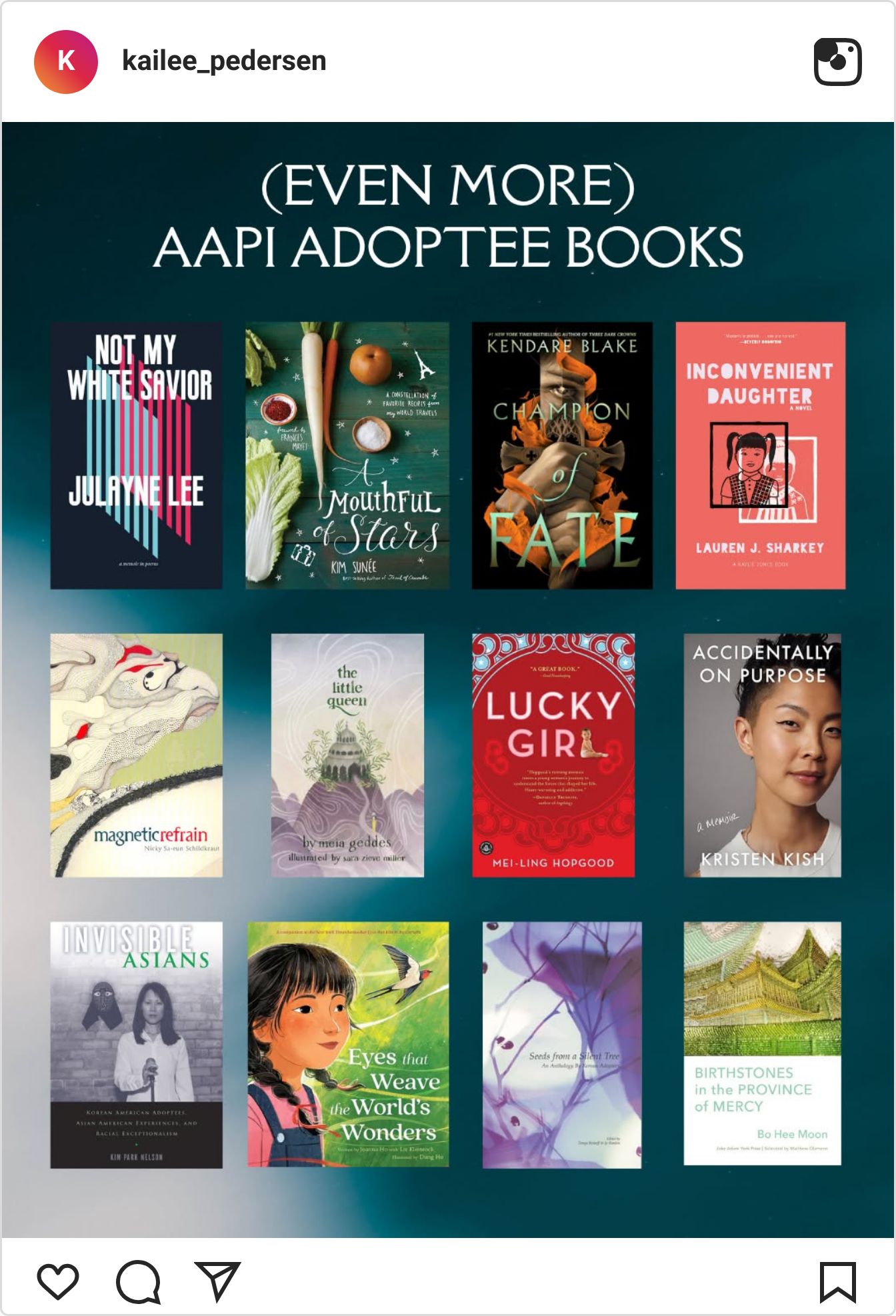
On Instagram, I was posting some compilations of Asian American adoptee authors—I haven't read all of them, but I definitely recommend folks check out memoirs and other fiction books. Folks are writing in a lot of different genres, which is wonderful because I feel like that's where you get the the real stuff.
I understand why people want to see a happier narrative, but I think the reality is that some of us have been human trafficked. Some of us have been abused. Some of us are not happy about adoption and the adoption industry. I think you have to take the bad [with] the good.
It can frustrate me because, especially in the publishing world, I feel like we're very categorized. Sometimes as an adoptee, I feel like I'm Asian with an asterisk. It's like people don't quite know what to make of my work. I'll never relate to Asian American culture or identity in the same way—which is okay. There's room for a lot of stuff out there.
I’m white and not a transnational or transracial adoptee. But I was adopted into a half-Latinx family, and my parents pressured me to identify as Hispanic when I applied to college. They’re conservative and thought it would give me an advantage through affirmative action. I refused to do it, even as a teenager. It made me so uncomfortable.
Still, I had the privilege to pass as my parents’ child. For adoptees like Mia and Oliver, who are visibly, racially different from their adoptive families, it’s a very different experience. You explore this in such a deep, rich way—not only through Mia and Oliver’s stories, but through Ryder, who distances himself from his queerness and Jewishness as he pursues professional achievements.
The hybridity of the experience [means] that you're both and neither. I think the line in the novel is like, “Neither Asian nor American, we might as well have been nothing at all.” This idea that if you don't fit into a box within society, people just ignore you or put you down.
Mia, partially due to her personality, never really finds community with other Asian people, and in fact, expresses a lot of not-so-great resentment toward other Asians, which is again part of her character. It's not something I'm condoning as the author, but I think that's real. You sometimes feel gatekept, or you can feel anxiety that you don't fit in.
For her, that turns an internalized hatred outward. I really wanted to draw a parallel between [kinds of] assimilation. Ryder chooses to assimilate to rise in the world of classical music, to discard his Jewishness and gayness in some sense.
And then there's Mia, who is forced to assimilate. She has no choice; she has left behind her Chinese name and her passport and her heritage, and is made into this new person. That is reflected in the destruction of [her] body, the destruction of self.
There are moments when Mia’s self harm almost read to me like a way of liberating herself from her body. I often wonder if that disconnection from the physical self is more common among adoptees.
I think my experience of writing Mia was that her self harm partially serves as discipline and regulation, which is part of the classical music themes. She's keeping herself in line. It's like an externalization of her own emotional abuse of herself, that she's trained herself to do.
I think some of it is also shame and guilt. Back to the assimilation theme, some of her self harm seems to center around, I would say, racialized features like her eyes and face, and then also her obsession with her teeth, which is prompted by feeling like there was something disfigured about them.
It's sort of Black Swan-esque—the pursuit of perfection, which is white and heterosexual. That's what a lot of people in the novel are pursuing, whether they want to admit it to themselves or not. Classical music is this breeding ground for so much [talent that is] queer, Jewish, and [from] people of color. Yet we are still forcing them to whiten themselves, essentially.
The conductor, who is probably one of the most repulsive characters in the novel, will continue to succeed in this environment. And there's nothing we can do about it.
He’s such a perfectly written villain. I was palpably angry whenever he was on the page.
He's so real. He's actually one of my favorite characters—not in the sense that I would like him if he existed in real life, but he's so interesting to write.
I really was trying to avoid this white male villainous character who's just straight up evil and advertising it to everybody. With him, I was really going for something much crueler and more sinister.
I think [he] actually, truly loves Mia. He's not lying when he says that. But he loves it because he can harm her. The centerpiece of their relationship is that she wants or desires his love, even though she knows it's horrifying and bad, and he truly loves her and cares for her. But he he does that because, as he says, “You try not to show it, but you're really easy to hurt.”
[He supports] female conductors and people of color, and I was really intent on that because the typical attempt at this type of villain is that he's extremely conservative, or you can tell he's about to be a harasser. I wanted him to be outwardly progressive, because I think that's so much more interesting and sinister.
That’s so true, and definitely a dynamic I’ve experienced in art scenes—a progressive white man who thrives on praise for platforming women and people of color.
I think he truly believes he's a good person. That’s one of the core things [about] his character. He platforms performers and composers of color. So what if he has sex with them when they're twenty? It's not his problem.
As time elapses, Ryder’s house becomes such a sensory experience of decay. I loved how richly you describe the environment, from moldy food in the refrigerator to grime accumulating everywhere.
At the same time, the house feels sacred. There’s something delicious about Mia finally getting to explore her mentor’s home, look through all his drawers, discover his secrets.
I actually started not with Mia, but with Ryder—this idea of a character named Ryder Wakefield, and that he'd be a composer. I was like, “Okay, who is he? What is he doing? And why does he have this wacky name?”
It's his chosen name, and [I] started with that. I'm queer, and I was really interested in exploring queer and Jewish musical history. As we were talking about the multiplicity of adoptee identity—I've been included in some Asian American roundup posts. I have never in my life been included as a Jewish author in anything. And I frankly know why. There's this sense of like, how Jewish am I? What does that mean for me, to have a Jewish adoptive father, but not to be—let's say—genetically Jewish, for lack of a better term?
And then, back to inheritance. What did I get from my mom and dad? What did I not get from my mom and dad? I don't know my biological family. I've looked, but it's pretty tough internationally. Where are they? Are they out there? And what do you lose when you don't know anything?
There’s so much to unpack with international adoptions. I don’t think people realize that adoptees have been deported because their adoptive parents don't get them citizenship.
For me, finding my birth parents was as simple as getting on Facebook, because my parents are in North America. My mom had been a dancer at Toronto School of Ballet, which is very uncommon, and my dad has an unusual Macedonian name. I had these little tidbits that I could corroborate. But for my friends who are international adoptees, it can be literally impossible because there are no records at all.
Now governments are saying, "Oops, we actually did crimes. Yeah, literal crimes.” What I do know, that we were told at the adoption agency, could all be lies, right? No clue. Kidnapping, human trafficking—anything could have been going down there. And they'll never own up to it.
Completely. And we’ll be told to be grateful for the adoption, too.
Yeah. I mean, I even have put that in [the book]. Mia [is asked], "Aren't you grateful?” And then she compares it to a grate on a prison cell.
Is there anything else you’d like readers to know about The Minimalist?
I think this book is for folks who feel that the past is the present—regardless of their identity or if they're adopted. And secondly, I don't really write books for didactic reasons or try to teach people anything. That's not really what I'm going for. But I think in some sense, this was my protest against the ways [we talk about] music education, classical music, and opera. Like Timothée Chalamet [saying] opera and ballet are dead, or that people don't really go to them or that they don't pay.
There is something to be said about the financial issues within the industry, and that they're not as popular as they once were and and all of that. Not that diversifying it isn't important, and not that we shouldn't consider ways of modernizing it or bringing it to more folks. That's what I try to do as a performer—I do a lot of free shows, and I really try to bring opera to the masses.
But I think as we're seeing with AI, the arts are at stake. Our spiritual nourishment. The way we interact with live arts like opera singing, and arts that take a lot of effort like classical music—which are no more or less worthy than other kinds of arts. But these are the arts that I've chosen to immerse myself in. Although [The Minimalist] does go very deeply into the challenges and issues within the world of [classical music], it is ultimately something of a defense of it. This is my passion towards it all.
There's a question that sort of goes unanswered, or is up to the reader: What would you destroy within yourself to be successful, and what would you destroy in others? And because this is a horror novel, I perhaps didn't quite get it in there—but a vision of the world in which we have these arts, and we're continuing to push them forward in a more collaborative way.
Up Next: Let’s Go to Creepaway Camp! (With Amanda Shafer)
This summer, a group of horror readers and writers gathered at a summer camp in Colorado. There were kegs and ghost stories, hiking trails and crafting, nostalgic cabins and early morning writing sessions, karaoke that continued for hours under the stars.
The mastermind behind Creepaway Camp is Amanda Shafer, a former Meow Wolf employee who is now devoting her creativity to delightful events and a brand new bookstore that’s coming soon to Denver. We’ll talk about it all in next week’s newsletter!

Scare Me! is a free weekly horror newsletter published every Thursday morning. It’s written by Michelle Delgado, featuring original illustrations by Sam Pugh. You can find the archive of past issues here. If you were sent this by a friend, subscribe to receive more spooky interviews, essays—and maybe even a ghost story or two.
