
Welcome back to Scare Me! a weekly horror newsletter. Today, we’re speaking with author Clay McLeod Chapman, a versatile storyteller who spins yarns in novels, on stage, and on screen.
Clay McLeod Chapman seems to be everywhere horror is happening. He’s perhaps best known as the author of Ghost Eaters, a 2022 grief horror novel about a drug that allows users to see the dead. An adaptation is currently in development, with Scott Derrickson (Sinister, The Black Phone) and Maggie Levin (V/H/S/99) attached. His latest novel, a horroromance called Devil Inside, is out next week!
When he’s not staying a step ahead of a busy publishing schedule, you can find Clay at just about any horror book event in the New York metro area. He’s an energetic presence, championing creepy creativity across all forms of media and rallying readers and authors alike.
Unusually, I didn’t go into our recent conversation with a specific angle in mind. I just wanted to know: What’s it like to be Clay? How does success feel from the inside?
I found him to be thoughtful, introspective, and gently vulnerable throughout our conversation—still in awe of the power of art, and seemingly unjaded despite decades in an unforgiving industry.
We went deep on the meaning of storytelling, the value of horror, and the books that he’s immersed in right now. I hope you enjoy the conversation as much as I did!

Thanks for reading Scare Me! Was this newsletter forwarded to you? Sign up to receive a new edition every Thursday.
Michelle Delgado: Clay! I’ve been so looking forward to talking horror with a fellow Virginian. You’re from Richmond, right?
Clay McCleod Chapman: I was born in Roanoke, and I lived there until [I was] five or six. And then [Richmond from] six to seventeen or eighteen—elementary school, middle school, and a part of high school. [Those were] formative years, when Richmond kind of put the imprint on [me]. I still love that city. I can't shake it.
We were a city that just wasn't that cool. DC was just two hours away, so the bands that would trickle down to us were really good. But if you really wanted to go catch something, you'd have to go the 9:30 Club. We did a lot of driving up 95 to get to the good stuff.
Oh yeah. I would leave class at U.Va. to make that drive…hit rush hour traffic…just barely get into 9:30. Hope my car's not broken into.
But I also spent a lot of time in Richmond when I was in college. That was something I really loved about Ghost Eaters—you really capture the city for people in that post-grad moment, the crash landing when you're going from art school into a normie job, and the rude awakening that accompanies that transition.
I have known characters like Erin and rolled my eyes at them, and I've also been Erin. It was humbling reading her journey.
Oh my god, it's so funny. I haven't thought about that character in a while. It is distinctly Richmond, but at the same time, we have that era of our life. Undergrad is like, “Oh my God, my circle of friends are geniuses, and we're going to change the world.”
Then you graduate, and you're like, “Oh, okay, I need to put a roof over my head, and I don't like the the the safety net is getting pulled away.”
But there was something so distinctly Southern about someone who is kind of slumming it in the art scene with the cool kids. And that suburban safety net of just crossing the James River and going back to the south side and the parents [who] will always take you back whenever you have done your flight of fancy. “We’re still here for you, hun!”
It is wild—take away the privilege, but just think specifically of college and how you're learning all of these things for the first time. It's like, “Oh my God, I'm learning about Lacan, I'm learning about Foucault.” It's expanding your worldview to the extent where you feel like you've discovered something that has not been discovered by generations of undergrads prior to you.
But that's what makes it so special—that it's your turn.
It was so relatable watching those characters run into the world's indifference at a thousand miles per hour. It's a moment that's so full of change and conflict, and that it makes it so ripe for horror.
Then you introduce really powerful elements of grief and addiction—some heavy stuff that college papers over. I'm sure we all knew people in college where you go from "ha ha, that person's so funny at a party" to "oh my God, that person can't go to work sober.” That's a big crash into reality.
I just love Ghost Eaters. I will admit that I was hoping to read more of your work before we spoke, and haven’t had the chance yet. But Ghost Eaters has really stuck with me.
We can stick with Ghost Eaters! Honestly, it's really interesting right now—I'm really fortunate that I've been able to write with the frequency that I have, and that publishers are willing to take a risk.
But there's always this moment [when] a new book comes out, and it's like, “Who am I going to lose this time?” There is that shedding of readers, which I guess is to be expected.

Yes, I've heard of that phenomenon—it's kind of the problem bands have, too. As an artist, you always want to try something different, but people are like, "Why didn't you just do the thing I liked last time?”
It's terrifying. The closest thing that I've had personally to a radio hit is Ghost Eaters. So that becomes the standard I'm evaluated by, and I haven't had a book that has registered to that frequency, to that scale, since.
Which—God, anyone would be so lucky to be a one-hit wonder. To have the one thing that anyone would remember. I would die to be like A-ha. I know it's a blessing and a curse, but being on this end of the equation, we should be so lucky to have something that lands like that.
That's something I was hoping to locate in our conversation—because to my eye, you’re hugely successful. You're in a prolific moment, with so many books out across horror, horromance, and YA. You host the monthly Fearmongers podcast. You write for screen. You've got a lot of irons in the fire, it seems!
I was curious to know: Do you feel like you're in a moment of prolific creation? Or have some of these projects been in the works for a long time, despite the fact that they’re arriving now?
I lucked out at a super early age and started working professionally at a point where I actually didn't have the emotional understanding of what it means to be a professional writer. I had to learn that retroactively. But it also gave me an opportunity to [ask] what can I do, and how can I utilize what I have and bring it to other mediums, other outlets?
When nobody wanted to publish me, I had an opportunity to write comics. And when nobody wanted me to write comics, I found my way to film. It was just the ethos of, any opportunity that presented itself to me, you just have to say yes.
I said yes to writing Broadway musicals. I said yes to ghost writing novels. Just anything. And it all was like, how am I gonna find myself, my voice, in this story?
You mentioned film—you know, things I wrote in 2015 are suddenly coming to fruition today. It's the longest of long games. I feel like you have to commit to the craft, because at the end of the day, that seems to be the only thing that is consistent. The money isn't. The accolades aren't.
It's wild how I've been writing for twenty-six years “professionally” and it wasn't until 2019 that anyone was actually starting to pay attention. It's been incremental, slowly but surely. I think it's just that yes mentality. Someone said, "Hey, have you ever thought about writing a YA? And I'm just like, "Yes, let's do it.” My editor at Harlequin Romance was like, "Have you ever thought about writing a horroromance?” And I was like, "Yes, let's do it.”
Some of it is fortuitous timing of what I've been doing, and people kind of acknowledging that or noticing. But you know, if you have the opportunity, you have to explore. You have to try. I think it's arguable that I've failed a lot more because of that. But as someone who wants to tell stories, being able to find my voice in other mediums or stories or niche genres—there's this value to exploring.
That's a distinct motivation, I think, that not everybody shares. It's occurring to me, as we're talking, that being motivated by storytelling is a different thing than wanting to write novels specifically. If you're open to crossing into different formats and media, that definitely opens up a lot of different opportunities.
That's what's amazing about storytelling in general. I love going to the movies—I'm the guy who will play hooky on a Friday afternoon and see a film. That feeds into who I’m hoping to be.
I would probably be more, quote unquote, “successful” if I committed to the one thing. I look at Rachel Harrison. I look at Nat Cassidy, Keith Rosson, Tananarive Due. I look at the people who have their eye on the prize, and the singularity of their function, and how they've succeeded at it.
It's so funny to hear the insider's view—because in my mind, you're one of the big dogs in horror right now! You've always got something new coming out, and it's just interesting to hear how elusive success always is. You can't really trap it and keep it. It's always something that's flitting away.
I think ultimately, we all have these black holes in our hearts that are never full.
Yeah, definitely.
It's that thing you're speaking of, about ambition. It's like the things we achieve are so flitting to ourselves that you can't even acknowledge or accept that they've happened. You almost have to look back in the rearview mirror of your life and say, "Oh, look, this is what I've done in the last year, the last five years, the last ten years.”
I think the biggest challenge is, can you be happy? Can you find happiness in this?
If you're happy, that's a testament of success, and that is honestly probably the most elusive thing. Because that's like, “If I only if I only do this, if I only get on this bestseller list, or if I only win this award, then I'll be happy.” Then maybe you get that thing, and then you're like, “Well then, maybe if I get on that bestseller list, or…”
That craven quality of ambition is something that I totally struggle with. I'm trying really hard to glance in the rearview mirror as much as possible, because I feel like I drive like this.
Tense, with your shoulders up by your ears—yep, same here.
What's in your rearview? What are some of those moments that you think back on?
To stick with Ghost Eaters, the experience of it coming to be is the [most] utopic artistic experience I've ever had. I had the idea, and through the development, the writing, the revising, the assembly—the good spirits that went into the creation of it [were] positive. Of course, it was stressful and there were certainly challenges internal to the process. But it was ultimately the most pure experience of of writing and discovering the story.
I think that had a lot to do with [my] emotional attachment to the material. But on the flip side, what makes it the complete experience was taking sales and tallies and numbers out of the equation. It wasn't a bestseller, it didn't chart. But over time, it's gone beyond me. People found it, enjoyed it, appreciated it, and said, "Hey, you should read this book.” And then that person would read the book, and that ripple effect…
Ghost Eaters has had the largest ripple effect. It's the furthest any book has gone beyond me, and in and of itself is such a wonderful, joyous [thing]. Literally, just last night, someone DM-ed me to say, "Hey, I want you to know that I just read Ghost Eaters, and it hit really hard for me because I lost my father.” People are telling me their personal stories with grief and loss, or with addiction, and that was not something that I had personally accounted for.
It's wild and it's beautiful when someone reads something and feels compelled to then either share or connect. That is what I constitute as success for a book like Ghost Eaters, where it has a life outside of me, and it compels certain readers to share themselves. That's a beautiful thing.
Lately I’ve been wondering, why do I love horror? I think where I've landed is that I've met so many people who have been through extraordinarily difficult circumstances—things you really can't discuss outside of very trusted relationships with maybe a spouse or a therapist. But horror gives us this opportunity to meet in a third place that's neutral.
With Ghost Eaters, we can talk about your boyfriend dying of an overdose, or hallucinations, or really severe mental health struggles, or a humiliating experience at work. Whatever the trauma is, we can talk about it—but there are ghouls or vampires or something else that lightens the experience. On one level, we're talking about a fictional drug trip, but on another level, we're talking about something way deeper, without having to expose ourselves.
I think horror gives people the chance to connect over our most fearful, most taboo traumas. That's such a rare and beautiful thing. It’s that emotional bedrock. It makes sense that Ghost Eaters has had that effect on readers, because it really is a book that taps into that in a really profound way.
Thank you. I mean, I think that's the value of art, and I think it's the value of horror—these metaphors of monsters. We read these books and we occasionally find ourselves in them. I think the vampires, the werewolves, the zombies, they are there on a certain level to provide an emotional catharsis that maybe life itself doesn't offer.
[You can] think of a book as a contained environment, a safe space to relinquish those emotions and feel the dread. But you can walk away from it. There's a great value to horror, whether it's film or TV or novels. It could be a total lark, it could be fun, but at the same time it's a mechanism for deeper emotions. I don't see any other genres doing that as well.
Horror to me is opera. It's like an emotional highlighter that just accentuates every feeling to such an intense degree that you're able to feel it much more immediately. There's a kind of sumptuousness to it. You love in horror, you fear in horror. In certain literary fiction—certainly not all—but some of it is like an exercise. Great work pulls that [emotion] out of you, but horror does it unabashedly. There's just something so grand about it.
That's what's so cool about giallo—the palette is much more vibrant and bigger and gestural.
You just came from an event today, and you have another one tomorrow. You're the go-to moderator! I feel like you are moderating an event any time of day or night. Anytime I go on social media, you are out there supporting other authors and championing their work.
What does that part of your work mean to you? I was really moved when, during her guest of honor panel at StokerCon, Rachel Harrison called you out as someone who really welcomed her to the genre and made her feel she had a home in it.
Man, that Rachel moment—there was not a dry eye in the house. Oh, I was crying! I was crying! When she she looked at me, I was like, "I'm not gonna cry. I’m not gonna do it.” But I couldn't hold back.
I met her in 2019, before The Return came out. We were on a panel and a signing at New York Comic Con, in the basement of the Javits Center, late at night with maybe five people coming to get their book signed. Nobody knew who the heck we were.
But Rachel handed me an ARC of The Return, and I was like, “Rachel's cool, I have this new cool book. I'll read it, what the heck.”
There's certain books that you read them, and it's like, “I'm no longer the person I was before I read this book. I'm now a different person.” Rachel changed me. We're all fans of her work. She makes it really hard not to be her fan.
So, to your question—I'm a fan. I feel as if the best conversation partner any author can have, no matter where they are in their career, whether it's Paul Tremblay or a debut author, you just want someone to really love your work. I love doing events with other authors because it affords me an opportunity to find a book that is easy to champion.
It's not hard to get excited. Books are an amazing art form, and having a chance to speak to the person who created it and get into their headspace—who wouldn't want to do that?
What is Clay Reading?
Toward the end of the conversation, we devolved into gushing about all the amazing books coming out this year, plus some deeper cuts that we’ve been catching up on.

Clay: Literally just yesterday, I finished Gus Moreno's new novel, If You Think You’re Lonely Now. I've been waiting years—years!—for his second novel. When I was reading it, I was like, “I'm in the presence of a master.” How rare is that? Maybe I'm just chasing the dragon, but they're out there.
Andy Marino—he's written this book that's coming out in November called Cold Empty Rooms, and it is one of the best books I've read in years. It's just profoundly upsetting, and stubbornly so. It's unforgiving and unsparing in the way that it asks you to be scared.
I read Yah Yah Scholfield's On Sundays She Picked Flowers for the first time this year. I read that in what, January? February? And [I’m still thinking about it].
Did you read Old Soul by Susan Barker? There are certain authors [who go] beyond just being original. It really feels as if we are exploring uncharted emotional terrain. The unfamiliarity of the horror is so unmooring. It’s scary to feel unmoored.
I love The Minimalist by Kailee Pedersen. The inevitability is so slow. Every page feels like a year in the mental headspace of of that character—it's like you exist outside of time. It is so internal. That one blew my mind. Kaylee's so good.
Annie Neugebauer—she is quietly redefining the sci-fi / weird horror genre. The Extra and The Other are just phenomenal books, profoundly upsetting in this way where they do so much with so little. She's an authors who insists that you come to her and read her work on her terms. Not in a mean or cruel way. It's just that the reader has to readjust or evolve.
Next up on the docket is Riley Sager's new novel, The Unknown. I'm excited about that. And then right after that is Chuck Wendig's The Calamities. I just ordered The Flayed Man by Chloe Lauter. I'm so excited.
Up Next: Wild Card!
I’ve had a wonderfully busy few weeks, full of interviews and zine news and learning how to edit audio. Thank you to everyone who made our podcast launch so special! Our next episode, with author Stacey Yu (Kitten) comes out tomorrow.
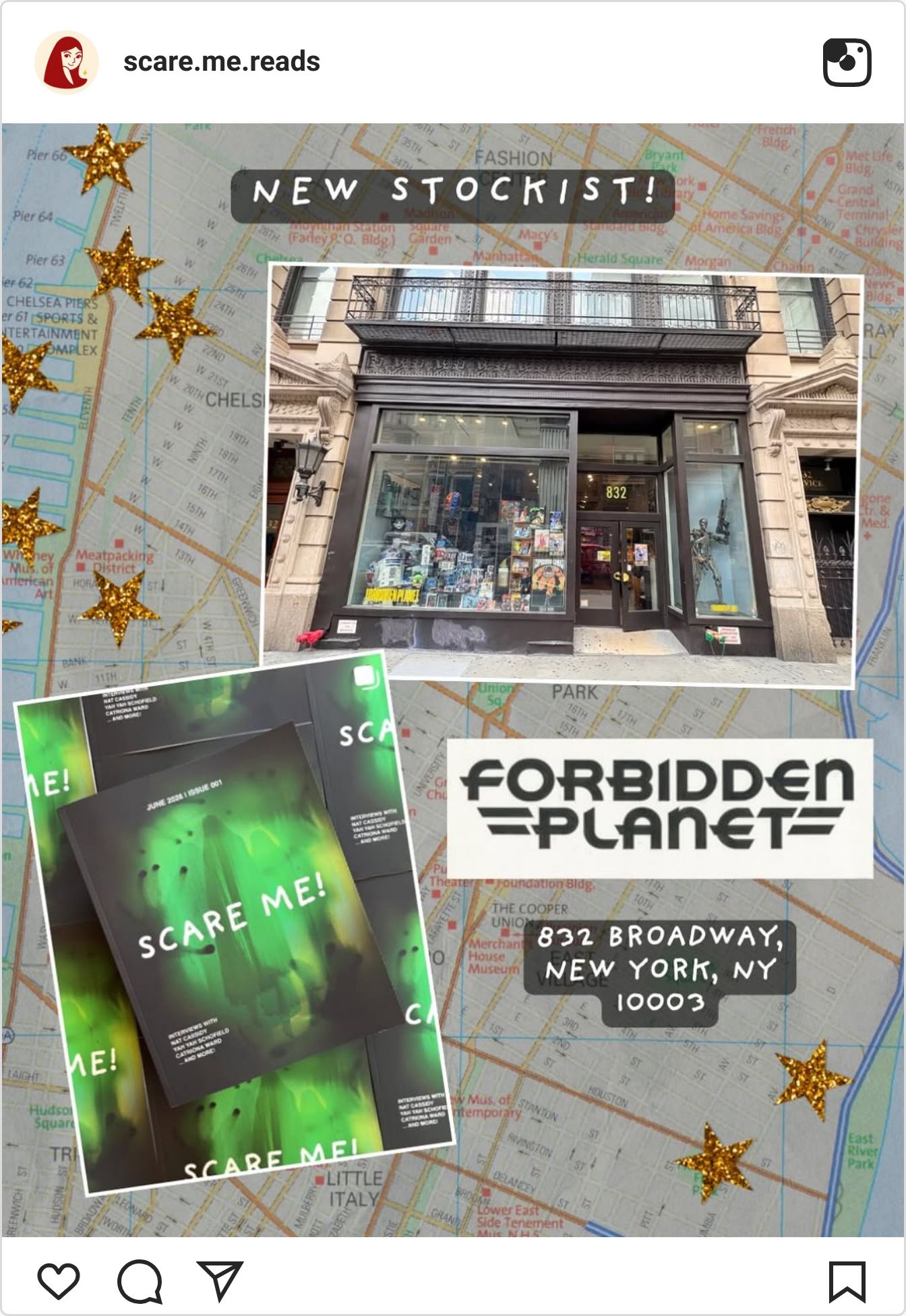
And if you’re in NYC, I sent a few copies of the print edition of Scare Me! to Forbidden Planet!
It’s been so much fun and so rewarding, and I want to take this weekend to let it all sink in. I’m going to let myself have a wild card next week to give my brain a break from editing interviews!
But after that, we’re in for back-to-back treats. I spoke with brilliant Kaylee Pedersen about The Minimalist, one of the most moving and deeply affecting books I’ve read this year. After that, we’ll go behind the scenes of Creepaway Camp with creator Amanda Shafer.

Scare Me! is a free weekly horror newsletter published every Thursday morning. It’s written by Michelle Delgado, featuring original illustrations by Sam Pugh. You can find the archive of past issues here. If you were sent this by a friend, subscribe to receive more spooky interviews, essays—and maybe even a ghost story or two.
